Thursday, 6 September 2012

Understanding the Dynamics of Islamic Radicalism in Nigeria is key to Bringing Boko Haram to Book

By Uyo Salifu, Researcher, Transnational Crime and International Crime Division, ISS Pretoria

Nigeria has started talks with the Islamic sect popularly known as Boko Haram in an attempt to remedy the security crisis that has crippled the country for the past two years. This dialogue takes place after much wrangling and procrastination on the part of both parties. While the attempt at dialogue is welcome, doubt remains as to whether this strategy will succeed. The decision to negotiate with a sect that the authorities had previously taunted as being a group whose days were numbered, could suggest that the government’s military approach has failed. Further, it seemingly indicates that the government has run out of options to contain Boko Haram on its own terms. Boko Haram’s incessant attacks, which have included suicide missions, bombings and gun battles, have claimed thousands of lives and injured many more. 

The quest for a lasting solution to the crisis must begin with an understanding of the root causes and the ideological motivations for youth participation in Boko Haram’s violent campaign. Boko Haram is the product of a long history of Islamic radicalisation that began in 1903 with the demise of the Sokoto caliphate, following Britain’s colonisation of Nigeria. The abrupt end of the Sokoto caliphate, which once served as an important centre of Islamic learning, led to a rise in radical tendencies among northern Muslims, who called for its reestablishment. This nurtured Islamic radicalisation in northern Nigeria and today fuels Boko Haram. Understanding the historical manifestations of Islamic radicalism in Nigeria is key to understanding Boko Haram’s grievances and addressing its violence. 

There is a misconception that the Boko Haram crisis in Nigeria is one between Muslims and Christians. Such a perspective fails to capture the root causes of the crisis and may mislead policy makers. Indeed, the historical dynamics continue to entrench Boko Haram as a domestic challenge to Nigeria. 

According to the historian Niels Kastfelt, the historical roots of Islamic radicalisation are found in the amalgamation of southern and northern Nigeria in 1914 and the emergence of constitutional regionalism and regionally based political parties in the 1950s. These events resulted in the politicisation of religion as affiliation to political parties developed on the basis of religion, particularly along Christian-Muslim lines. An additional factor is the emergence of the ‘maitasine revolution’ in the 1980s, which centred on purifying Islam and rejecting aspects of Western civilisation that were perceived to corrupt Islamic reverence. This was expressed through violent riots in places like Jos, Kano and Kaduna, where over 4 000 people died and several more were injured.

Islamic radicalisation denotes the pursuit of revolutionary change on the basis of strict adherence to a set of Islamic beliefs. Expressions of Islamic radicalism may be violent or non-violent. It is therefore not uncommon for radical groups to pursue their objectives peaceably. Boko Haram started off as a non-violent radical Islamic group, but began to employ violent tactics in 2004. Although other Islamic groups exist in Nigeria, Boko Haram has emerged as the most violent. Groups such the Yan Izala and the Al-Sunna Wal Jamma have been in existence since 1978 and 2002 respectively, but are not as popular as Boko Haram.

The potent combination of socio-economic and political inequalities currently leads to violent expressions of radicalisation in Nigeria, as well as the rise of Salafist ideology, which is based on a fundamentalist interpretation of the Qur’an. The latter is perpetuated by the prevalence of radical madrasas or religious schools. Boko Haram has used such schools to promote its objectives of establishing a shar’ia state in Nigeria and eliminating the influence of Western education on Islam. The recruitment and violent radicalisation of Boko Haram members have also been conducted through prisons. In September 2010, for example, Boko Haram orchestrated a prison break that resulted in the release of approximately 750 prisoners. Only 100 of these were alleged to have been Boko Haram members. In June 2012, the group broke into another Nigerian prison, releasing 40 inmates. These events show the importance of prisons in recruitment. In addition, Boko Haram has also used the social media, including the Internet and YouTube, to promote its objectives, including radicalisation and the recruitment of youths.

However, the group has criticised the media for inaccurate reporting on its activities and statements and for erroneous information on its dealings. The bombing of the offices of This Day, a Nigerian popular newspaper, was a demonstration of its grievances with the media. Nigerian forces have responded to Boko Haram with attempts to violently suppress the group through killing several of its members. Boko Haram has, nonetheless, remained obstinate in its objectives. Addressing the challenge of radicalisation requires measures that transcend simply crushing Boko Haram through military means. Violent responses may temporarily quell the revolt, but it will more likely than not just produce variants of the group. The current dialogue with Boko Haram is also unlikely to produce a sustainable outcome, as giving in to the group’s demands could promote impunity rather than mitigate insecurity. The group’s recent demand for the release of all its members in police custody is likely to send the wrong message to other radical groups on the government’s stance on radicalism. 

A more long-term solution to violent radicalisation includes a robust criminal justice approach that combines sound military strategies with effective legal measures. Such an approach requires the use of Nigeria’s counter-terrorism legislation to prosecute crimes committed. More so, the rule of law needs to be efficiently applied across the board. It also involves the full capacitation of law enforcement to adhere to human rights in addressing crimes. The Nigerian government must also address the root causes of the phenomenon through concerted efforts to address endemic corruption and poor governance. Widespread corruption is responsible for the absence of trust in the government and the general feeling of hopelessness concerning the state of affairs. Linked to corruption is the underdevelopment in northern Nigeria, which should be tackled comprehensively. The government must also collaborate with religious clerics and the community at large to build trust with northern Nigeria. These measures will engender a feeling of inclusion among the people and decrease the rationale for violence. Beyond this, the challenges created by the media in reporting inaccuracies should be addressed by thorough sensitisation of the media on reporting on issues such as radicalisation.  
 

Tuesday, 4 September 2012

Israeli attack will meet Iran's great response: Nasrallah


Via Press TV
Hezbollah Secretary General Seyyed Hassan Nasrallah says he does not believe Israel will attack Iran in the “foreseeable future,” warning that Tehran’s response to any potential assault will anyway be “great.”

"Personally, I do not expect the Israeli enemy - at least in the coming months or foreseeable future - (to wage) an attack on the Islamic Republic of Iran," Nasrallah said in an interview with the Beirut-based Al Mayadeen television on Monday.

"A decision has been taken to respond and the response will be very great," Nasrallah added.
"The response will not be just inside the Israeli entity - American bases in the whole region could be Iranian targets… If Israel targets Iran, America bears responsibility,” the Hezbollah leader said.

Nasrallah added that there were disagreements among Israeli officials over attacking Iran's nuclear facilities.

On Sunday, Israel’s former Supreme Court judge Eliyahu Winograd lashed out at Prime Minister Benjamin Netanyahu and Minister for Military Affairs Ehud Barak for their “extremely irresponsible” statements about striking Iran.

“I'm not familiar with their [Netanyahu and Barak’s] considerations, but their [statements] are extremely irresponsible,” Winograd said.

"The chiefs of the entire defense establishment - Shin Bet and Mossad chiefs past and present, Military Intelligence - they all oppose a strike but Netanyahu and Barak alone will decide?” he asked.

The US, Israel and some of their allies accuse Tehran of pursuing military objectives in its nuclear energy program.

Tel Aviv has repeatedly threatened Tehran with a military strike to pressure it to halt its nuclear energy work.

Iran refutes the allegations over its nuclear energy program has promised a crushing response to any military strike against the country.

Monday, 3 September 2012

Who is Fooling Who? Netanyahu has lost his wits over Iran: Mofaz


Via Press TV
The three integral men
The leader of the Israeli opposition party Kadima has blasted Israeli Prime Minister Benjamin Netanyahu for his war rhetoric against Iran, saying the hawkish premier has “lost his wits”.

“He seems to have lost his wits, and rather than making thought-out, responsible decisions, he is creating the sense of an impending war,” Shaul Mofaz said Sunday, following his last week’s meeting with Netanyahu where they discussed Iran.

Netanyahu seemed “confused, stressed out and unfocused” over the issue of Iran, Mofaz added.
“The prime minister has lost the faith of the security chiefs, United States President [Barack] Obama, and [Israeli] President Shimon Peres,” said Mofaz. “This is a bankrupt leadership.”

He added that there is a direct relation between Tel Aviv’s bellicose rhetoric against Iran and the economic woes in Israel.

“You cannot put the country into the frenzy of war,” he said. “There is a direct correlation between the talk of war, the economic situation, and people’s despair.”

Recently, thousands of Israelis have held demonstrations in Tel Aviv, protesting against social inequality and the government’s austerity measures.

Israeli demonstrators, furious and concerned about a potential Israeli attack on Iran, have also been protesting against the warmongering policies of the Israeli regime in the recent months.

Mofaz also supported the remarks made earlier Sunday morning by former Israeli Supreme Court justice Eliyahu Winograd, who described the talk by Netanyahu and Defense Minister Ehud Barak about an aggression on Iran as “extremely irresponsible.”

According to Mofaz, Winograd “joins a long list of people” who have expressed strong opposition to a possible Israeli strike against the Islamic Republic.

“Winograd’s primary arguments against an early strike have also been voiced by every head of the defense establishment, the president of the United States, and an ongoing stream of highly placed administration visitors” to Israel, Mofaz said.

The US, Israel and some of their allies accuse Tehran of pursuing military objectives in its nuclear energy program with Tel Aviv repeatedly threatening Tehran with a military strike.

Iran refutes the allegations and maintains that as a signatory to the nuclear Non-Proliferation Treaty and a committed member of the International Atomic Energy Agency, it has every right to develop and acquire nuclear technology for peaceful purposes.

Iranian officials have also promised a crushing response to any military strike against the country.

CCM and Police want to make Chadema look bad: It will not work!

The killing of a TV journalist by a police tear gas canister in Iringa is another attempt by the ruling party CCM to tarnish the image of peace loving Chadema party. It has been reported that David Mwangosi of Channel Ten TV died after been hit by a police tear gas canister. Chadema are on a nationwide campaign to popularize the Movement for Change (M4C) agenda. They were opening a party branch in Mufindi South village. The Tanzanian police have come under heavy criticism lately for their blatant disregard of peaceful mass gathering more so from the opposition Chadema. It has just been few days since a young man lost his life in Morogoro town during a Chadema meeting. There is no doubt that this is a deliberate tactic by the CCM government in cohorts with the Police to tarnish the image of Chadema. The opposition party is peace loving and embodies the image for change which the people of Tanzania are now in concert. These attempts to make Chadema look as trouble rousers should be condemned outrightly,

Democratic transitions dont come smoothly. Democratic space comes with a fearless drive for change across the societal divide. The opposition party Chadema is already showing the way. Open and transparent media are trying to spearhead this despite the frivolous attempts by the government to oppress them. Civil Society Organizations, both local and international should come out strong and midwife this process. The integral component of this struggle however is the people. I must admit that the people of Tanzania are now showing signs of political maturity by embracing change. The gestation period of a democratic Tanzania is coming to birth. Let us not relent in this pursuit. Government hindrances and opposers of a democratic Tanzania should not be left to triumph, let us rise to see a Tanzania that will wake up and compete in the region, continent and globally.

I urge the people of good to drive this agenda. The party that will act as a vehicle to this process is non-other than Chadema. Long live Tanzania, long live Chadema party. God Bless Tanzania.

Friday, 31 August 2012

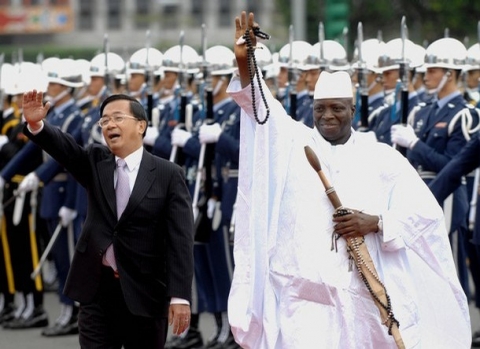
The Gambia: President Yahya Jammeh's order to execute prisoners is an assault on human rights progress


 Via CPRA Daily Briefing
In a speech given during celebrations of the Muslim Eid el-Fitr, the Gambia's President Yahya Jammeh announced a plan to have all death row prisoners executed. The subsequent executions sparked worldwide condemnation and lifted the veil on the increasingly authoritarian regime in the Gambia. They are also likely to raise concerns over the country's democratic credentials.

The African Union (AU) and various human rights organisations tried to persuade President Jammeh to abandon this plan, but were unsuccessful. On Sunday 26 August, nine prisoners were hastily executed by a firing squad during the night. Some have argued that President Jammeh could well take advantage of this to rid himself of political figures accused of plotting against his regime.  According to Amnesty International, there are currently 38 more death row prisoners awaiting execution. The US State Department has called on President Jammeh to review the remaining cases and ensure that the Gambia does not stray from its own or from international law, as it is suspected that due process has not been followed in these executions. Two of the prisoners executed on Sunday were Senegalese nationals. Senegalese Prime Minister Abdoul Mbaye has formally protested against the executions and has asked Gambian ambassador Mass Axi Gey that the life of a third Senegalese death row prisoner be spared. 

Considering the fact that President Jammeh has thus far ignored the pleas of the AU and many other international bodies, it seems unlikely that the executions will be halted by Senegal's request. As a result President Jammeh's decision is not only further damaging the questionable human rights record of the Gambia, but is also damaging relations with its neighbours. While President Jammeh in the past has announced his ability to cure AIDS and infertility, and has said that all homosexuals will be beheaded, his latest decision still comes as a shock. 

Yet the Gambia hosts the African Court of Justice (sic) [African Commission on Human and Peoples' Rights (ACHPR)] , and is thus meant to be a hub of human rights, but the plan to keep executing prisoners is a clear indication of the reversal of the human rights progress and a regression in the democratisation process. In addition to this, the Gambia is yet to sign and ratify the 1989 Second Optional Protocol on the International Covenant on Civil and Political Rights (ICCPR), which is aimed at abolishing the death penalty. Disturbingly, Sunday's events mark the first executions to take place in the Gambia in 27 years. This raises serious questions as to why the President would want to reverse this good record. Unfortunately, the situation does not seem to be unique to the Gambia, as out of 54 African countries only 16 have legally abolished the death penalty to date. 

In addition to the global move to abolish the death penalty, backed by the Second Optional Protocol of the ICCPR, there is an ongoing debate on how, in the rare cases where execution is decided upon, the person should be executed. If lethal injections, which were once thought to be the most humane form of execution, are no longer considered to be all that humane, then death by firing squad (as practiced in the Gambia) is certainly not humane. 

As mandated by their domestic law and the fact that the country did not sign the Second Optional Protocol of the ICCPR, Gambian authorities believe they have the right to continue to practice the death penalty in cases of murder and treason. However, the way in which President Jammeh is going about the executions bodes ill for his country. The Gambia has signed the 1984 Convention against Torture and other Cruel, Inhumane or Degrading Treatment or Punishment, but because it has not been ratified it is not legally binding. This is quite concerning as prisoners on death row are often in danger of being subjected to torture or cruel, inhumane treatment. The Gambia will have to amend its domestic law if it does not wish for its image to be irreversibly damaged by this lack of due process and lack of legal protection for prisoners. 

President Jammeh said that he decided to have the death row prisoners executed since he could not allow 99 per cent of the population to be held hostage by one per cent. However, by making this decision, he forced the Gambia back into a global minority of countries that still practice capital punishment. Considering the direct correlation between human rights progress and development, this raises the question over who is really holding the Gambia hostage.

Real power is in national will, not nuclear weapons: Ayatollah Khamenei

 
Mugabe and Ayatollah Khamenei
Via Press TV
Leader of the Islamic Revolution Ayatollah Seyyed Ali Khamenei says the real power of a country lies in the reinforcement of the national resolve and progress in scientific and social spheres, rejecting nuclear arms as a component of a nation’s power.


“We consider real power in strengthening the national will and socio-scientific advances, not in atomic weapons,” Ayatollah Khamenei said Thursday in a meeting with Zimbabwean President Robert Mugabe who is in Tehran to participate in the 16th summit of the Non-Aligned Movement (NAM).

Ayatollah Khamenei called on all NAM member states to adopt practical measures through collective cooperation.

Mugabe, for his part, denounced Western countries’ “big lies about defending human rights, law and democracy,” adding that “The record of the US, England and France and their double-standard behaviors towards the developments in the Middle East show that Westerners are merely after oil resources.

The Zimbabwean president said the approach of the West to Syria is indicative of a tenuous and fragile plot to undermine the Islamic Republic.

He also denounced as “ridiculous” the Western powers’ allegations that Iran is seeking to acquire military nuclear capability.

NAM, an international organization with 120 member states, is considered as not formally aligned with or against any major power bloc. It represents nearly two-thirds of the UN members.

At the opening ceremony of the NAM expert-level meeting, Iran assumed the rotating presidency of the movement for three years. Egypt's Ambassador to the United Nations Mootaz Khalil formally handed over the presidency to Iran.

Wednesday, 29 August 2012

Iran's Foreign Minister Says Morsi Visit Is a 'Landmark'

 Via Al Monitor
Iranian Foreign Minister Ali Akbar Salehi said Tuesday that his government will not be offended if Egyptian President Mohammed Morsi spends only a few hours in Iran later this week. In an interview with Al-Monitor and Time Magazine on the sidelines of a conference of the 120-member Non-Aligned Movement (NAM), Salehi said the mere “presence” of an Egyptian leader in Iran after decades of estrangement between Iran and Egypt would be a “landmark.” Salehi repeated Iranian offers to help resolve the crisis in Syria — offers that the Barack Obama administration has rejected. The soft-spoken foreign minister, who got his PhD in physics from MIT before the 1979 Iranian revolution and previously served as Iran’s representative to the International Atomic Energy Agency, also said he remains optimistic that a “win-win” solution can be found to Iran’s nuclear confrontation with the US and much of the international community despite the current apparent deadlock in talks between Iran and the five permanent members of the UN Security Council plus Germany (P5+1).

[ZELEZA] Malawi’s Political Earthquake: Nullification of the Presidential Elections

By Prof Paul Tiyambe Zeleza  3/2/2020 The Malawian Constitutional Court has annulled last year's presidential election results....

Most Viewed