The Supreme Court of Kenya upheld Uhuru Kenyatta's controversial win after it had ordered a fresh elections in a judgement on 1 September 2017. A fresh election which was boycotted by the main opposition NASA, was conducted on 26 October. Uhuru Kenyatta won by 98.2% in an election that witnessed extreme low voter turnout. Two petitions were filed challenging his victory. The Supreme Court, in a unanimous decision concluded that the petitions challenging Mr. Kenyatta's victory lacked merit.
Showing posts with label Nasa. Show all posts
Showing posts with label Nasa. Show all posts
Monday, 20 November 2017

Thursday, 27 July 2017
Political and Ethno-Demographic Calculations in NASA’s Endorsement of Governor Mandago
All politics is local. It is
kitchen sink time ahead of the anticipated general elections in Kenya on 8
August. The two leading political outfits Jubilee and NASA are crisscrossing the
country in attempt to win the hearts of people. Incumbent, President Uhuru Kenyatta
snubbed
the president’s debate citing it as a “waste
of time” much to the chagrin
of the Kenyan people. His die-hard supporters have however, defended his
decision. His close competitor Raila Odinga chose to attend the debate and with
the latest Infotrak
showing he has a one-point lead to President Kenyatta, he will definitely be buoyed
and confident going into the elections. A corresponding
Ipsos poll however, shows Uhuru in the lead. Much of the campaign message
after the debate has been about the decision of Uhuru to skip the debate.
Despite this spin, one
interesting thing happened during NASA’s campaign in Uasin Gishu county. In an
area known to be the bedrock of Jubilee support, it is largely expected that
NASA will get very few votes. However, with the local ethno-demographic and political
play, NASA has seen an opportunity to eat-into the Jubilee votes.
Ethno-demography in Uasin Gishu
County
Incumbent governor Jackson
Mandago who won the Jubilee nominations in April, 2017 is facing a tough
reelection. His closest and fiercest opponent is Zedekiah Kiprop Bundotich alias
Buzeki who is an independent candidate. These two had actually squared off in
the Jubilee nominations with Mandago defeating Buzeki – who felt aggrieved and
decamped and is now running as an independent. Buzeki is known to be wealthy
and as the story goes, enjoys the support of the Deputy President William Ruto –
the Rift Valley kingpin. A recent poll by Infotrak indicates
that Buzeki (54%) is ahead of Mandago (42.1%) in the governor’s race. Buzeki
has been gaining momentum since his decision to run as an independent.
In June, the Star
Newspaper wrote an analysis of the battle-royal between the two – saying that
Buzeki was no storm in a teacup. The analysis indicated that Mandago, who is an
ethnic Nandi – the majority in the Kalenjin tribe is a poor orator and lacks
charisma to pull crowds. The ethno-demography is further evidenced in Buzeki
who is a Keiyo – another subtribe of the Kalenjin and married to a Kikuyu. The
historicities of the ethnic politics in Rift Valley and Kenya are known to play
a key factor in elections. Kenya’s political culture is read through ethnic
mobilization and balkanization. That notwithstanding, the interplay between the
Nandi-Keiyo/Kikuyu in Uasin Gishu is threatening the reelection of Mandago. Deputy
President William Ruto has pleaded with Buzeki to drop
his bid but Buzeki remains adamant that he wants the governorship position.
Mandago has “accused” the Kikuyus in Uasin Gishu of supporting his opponent –
something he says is not good for Jubilee unity. Reports indicate that a Kikuyu
interest group in the county would prefer Buzeki, their in-law to safeguard
their interests.
NASA Prey in Uasin Gishu
The continuing ethno-demographic
mobilization in the county has enticed the opposition NASA – who like the
proverbial grasshopper fight that benefits the crow. Earlier, there was talk
that a Buzeki withdrawal from the rest would have forced his supporters to vote
for NASA. However, with Buzeki still in the race, NASA has decided to wade in. Speaking
in Eldoret, NASA leaders pledged
support for Mandago. “If I was voting here in Eldoret, I would have voted
for Mandago,” said NASA running mate Kalonzo Musyoka. On his part, Moses
Wetangula said that he stood with Mandago because he was “oppressed”. Bomet
governor Isaac Rutto also weighed in sending greetings to Mandago much to the
jubilation of the crowd. The thinking of NASA is that a section of Jubilee
leaders is backing Buzeki and not Mandago.
NASA game plan
NASA’s endorsement of Mandago can
be analyzed in three ways. Firstly, NASA and indeed Mandago, believe that William
Ruto is supporting Buzeki. They say the enemy of your enemy is your friend. Through
this endorsement, NASA sees an opportunity of receiving presidential votes in
Uasin Gishu from Mandagao supporters. What will it take to have Mandago
supporters, who are also Jubilee supporters to vote for Raila Odinga of NASA?
This remains highly unlikely. Jubilee has found it hard to sell its six-piece
voting pattern especially in areas that it enjoys massive following such as
in Central Kenya and in Rift Valley. However, on the ethno-demographic balance,
NASA could receive rebel votes from Mandago Jubilee supporters as well as from
other NASA allied tribes living in the county. The script here is again focused
on 2022 succession politics of DP William Ruto – who wants to have his “men”
ahead of his anticipated 2022 presidential bid.
Secondly, with the tightness of
the elections as predicted by two polls Infrotrak and Ipsos, the game plan for
NASA seems to also focus on a potential runoff. If Buzeki wins the race,
Mandago livid and disfranchised supporters will be inclined to vote for Raila
Odinga in the runoff - thus tipping the
scales in favor of NASA. This is a futurist calculation which NASA hopes to
cash on in the event there is a runoff.
 |
| Governor Mandago and William Ruto |
Thirdly, NASA’s endorsement of Mandago’s
is a crafty attempt to eat into Rift Valley votes having already done so with
the inclusion of renegade Bomet governor Isaac Rutto. With the ethno-demographic
interplay, it is expected that NASA will eat into the Jubilee stronghold of
Rift Valley. Aware that the electoral dynamics change every day, it remains to
be seen if the new-found NASA love for Jubilee’s Mandago will yield any
success.
Monday, 10 July 2017
Campaign Songs and the 2017 Elections in Kenya
With the Kenyan
elections at fever pitch you must have heard NASA’s campaign song “Tibim” and
Jubilee’s “Tano Tena”. I look at how the campaigns have been shaped by the
songs adopted as campaign songs by the two-leading political entities in Kenya.
Since the wave in
the reintroduction of multiparty electoral politics in Africa in the 1990s, the
world has been treated to the ups and downs that have come with multiparty elections
in Africa. Africa has come a long way in electoral politics. Nic Cheeseman in
his book Democracy
in Africa: Successes, Failures and the Struggle for Political Reform
brings out the challenges to democratic consolidation in Africa citing the
examples of numerous states. I have taken much interest in elections and
election studies in Africa, reading numerous works by both Western and African
scholars who analyze the road to democracy in Africa. Particularly, I have been
a keen follower of the Kenyan electoral process since 1997 when I was still in
Primary School in Lukenya Academy. Having spent my entire formative years in
Kenya, I have observed the electoral process since 1997 when President Daniel
Moi was reelected. The 1997 elections were interesting, and as a young man, I
recall the party symbols that were used. Moi and his party KANU had the ‘jogoo’
as the party symbols while Charity Ngilu’s SDP had the clock. She was a phenomenon
then, people referred her “Masaa ya Ngilu”. Raila Odinga who ran on the
National Development Party (NDP) had the symbol of a tractor – and people
called him “Tinga”.
The elections of
2002 were historic in Kenya. With the merger of the opposition under the NARC
umbrella, they were able to oust Moi’s project Uhuru Kenyatta. Mwai Kibaki was
sworn in as president on a wheelchair at a memorable occasion in Uhuru Park. It
was my final year in Primary School and the mood around the country was
electric. The election in 2007 was followed by the unfortunate descent into
election violence. ODM Party candidate Raila Odinga contested the election
outcomes leading to reprisal communal attacks in many parts of the country. The
2013 elections ended up at the Supreme Court, where Raila Odinga’s coalition
CORD unsuccessfully contested the outcome.
Siasa
Kenya
Despite the
ethnized nature of Kenyan politics, one interesting thing is the fanfare that
characterizes the electioneering process. I have not known a day in Kenya where
politics is not discussed. The end of an election in Kenya is the start of
politicking and planning for the next election. There is never a dull moment in
Kenyan politics. As part of my literature review for my PhD thesis, I have
gathered a lot of material on elections and electoral politics in Africa. One
text that has drawn me to the Kenyan elections in Multiethnic
Coalitions in Africa: Business Financing of Opposition Election Campaigns
written by Leonardo Arriola. The book looks at patronage politics, ethnic
cleavages and democratization in Africa. Its analysis touches on the asymmetry between
post-colonial Africa and the ethnic mobilization in countries in Africa. Kenya
falls under this analysis of ethnic balkanization and ethnic mobilization in
the form of coalitions. The rise of ethnic coalitions in Kenya is a testament
of the deep lying ethnic issues in the country. Party populism in Kenya is
based on how much an ethnic leader can marshall his tribesmen and those of
other tribes’ people to outdo the others.
Creativity
in Campaign Songs
Despite the doom
and gloom, Kenyan politics remains interesting especially on the creativity in
the campaigns. The 2017 elections have been made more interesting by the
campaign songs. Campaign songs add to the glitz and glamor of elections. The
two major coalitions Jubilee and the
National Super Alliance (NASA) have
incorporated campaign songs that mobilize the electorate. Whereas campaign
slogans are aimed at capturing the attention of people during campaign rallies,
campaign songs generally radiate the mojo of the electorates. Jubilee’s
campaign slogan is “Tuko Pamoja” which translates to we are together while that
of NASA is “Mambo Yabadilika” meaning Change.
The two parties don’t
have official campaign songs but some local artists have crafted campaign songs
that have been adopted by NASA and Jubilee in their campaign trail. Tanzania’s
ruling party CCM is known to have good campaign songs which were composed by
the Tanzania One Theatre (TOT) Band. In the 2015 elections for instance, CCM
outdid its closest rival Chadema with the hit song “CCM Mbele kwa Mbele”. By
all means, the song must have been the song of the year in 2015. It spoke to
the CCM supporters and also lambasted the opposition in very crafty manner. “CCM
ni ile ile, oh ni ile ile… mwaka huu watatukoma,” these were some of the lyrics
that galvanized the CCM base.
Nasa Tibim,
Raila Tibim!
NASA has several
songs that it has adopted for its campaign. Going by their coalition slogan “Mambo Yabadilika” the
NASA coalition has adopted Hellena Ken’s gospel song with the same title to
signify their change message. The song by Hellen Ken has been popularized by
the NASA coalition and it is now synonymous with them. Going by the change
theme, a Luhyia artist Amos Barasa has released the song “Bindu Bichenjanga”
singing about change. The glitzy Luo song “Tibim” by Onyi Jalamo
has so far been the most reverberant NASA campaign song. “Tibim” song
recognizes all the NASA leaders led by its presidential candidate Raila Odinga,
running mate Kalonzo Musyoka, Musalia Mudavadi, Moses Wetangula among others
such as the Nairobi governor Evans Kidero. These songs add to the glitz and
fanfare at rallies before the leaders make their speeches. Artist Lawi has also added
to the list of the NASA songs as well as Sweet Star, the Kalenjin artist who
has a Kalenjin remix Tibim
song. The NASA team has also used Tanzania’s hit song “Muziki” by Darassa
featuring Ben Pol to respond to Jubilee’s attacks with Raila telling off
President Kenyatta “Blah
Blah sitaki kusikia” then he dances as the song rolls on. Raila, popularly
known as “Baba”, “Tinga”, “Agwambo” or “Jakom” or “Joshua” has had many songs
by his tribesmen which idolize and praise him. One example is that by lady
Maureem titles “Raila Jakom”. Kamba artist Ken Wa Maria has also sung a song
praising Kalonzo Musyoka titled “Kalonzo ika nesa” which
is sang in campaign rallies before Kalonzo speaks.
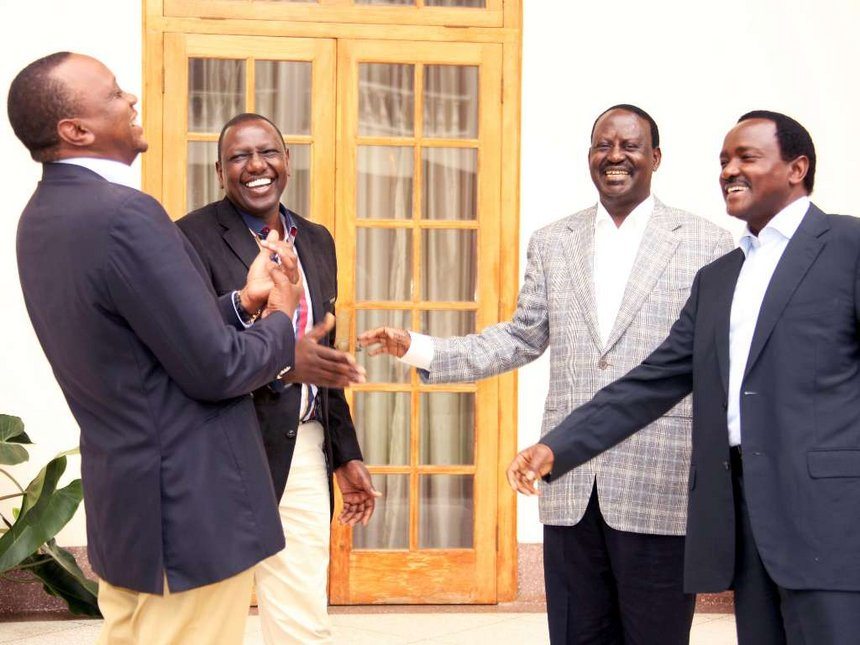 |
| Kenyan top leaders share a joke |
Jubilee,
Tano Tena!
Kikuyu Gospel
artist Ben Githae has released a campaign song in praise of Jubilee and its
leaders incumbent Uhuru Kenyatta and William Ruto. The song “Uhuru na Ruto Tano Tena”
is a reminder of the much Jubilee has achieved in their first term in office
and urges people to reelect them. The song in Swahili highlights the successes
in the Jubilee administration. I have also come across a song by Kamande wa
Kioi, a popular Kikuyu artist who sings praises to Uhuru Kenyatta. The song “Uhuru ni witu” sang in
Kikuyu was a prayer request to have Uhuru freed from the ICC yoke before his
election in 2013.
Onyi
Papa Jay 2007 Song
However, the
best campaign song has to be Onyi Papa Jay’s ODM song of 2007. The
song combined Swahili and Luo lyrics to capture the process leading to the 2007
elections. The song gives a historical analysis of the formation of the ODM
party. Combining Swahili and Luo narratives, the song gives details of the 2005
referendum that was won by the Orange team. The ODM team was led by the then
Pentagon of Raila, Ruto, Mudavadi, Nyaga, Balala and Ngilu. Using Raila’s
football commentary analogy, Onyi Papa Jay passionately narrates how ODM was
going to beat PNU in the elections.
Campaign songs are
important in mobilizing electorate around an agenda ahead of an election. Songs
generally are an important medium of cultural expression in all societies. The
campaign songs in Kenya explain the nature of Kenyan political landscape which
is largely ethnic. However, the songs have also been embraced by the ethnic
communities that make up the specific coalitions.
Nicodemus Minde
Nairobi, Kenya
10 July 2017
Subscribe to:
Posts (Atom)
Most Viewed
-
Chadema Blog: CHADEMA yanasa wasaliti : SHONZA, MCHANGE, MWAMPAMBA WATIMULIWA BAVICHA MBUNGE wa Maswa Magharibi, John Shibuda (CHADEMA), ...
-
 By Nico Minde Tanzania and Malawi are embroiled in a boundary issue over Lake Nyasa as it is widely known in Tanzania or Lake Malawi as i...
 -
Jana, Jumapili, jua angavu na hali ya hewa tulivu. Nipo katika shughuli zangu za kawaida za Jumapili. Natizama mechi ya Ligi Kuu ya Uingere...