Showing posts with label Raila Odinga. Show all posts

Wednesday, 29 November 2017

Speculating Magufuli’s absence at Uhuru Kenyatta’s Inauguration

29 November 2017
As I drove on the Thika Superhighway on the weekend before Uhuru Kenyatta’s inauguration on Tuesday, the road was decorated with flags of different countries. At the foot-bridge next to National Youth Service (NYS) Headquarters, the Tanzanian flag flew sublimely. Other flags including the Nairobi City Council flag decorated the Thika Superhighway that headed towards Kasarani, the venue of the inaguration. The Office of the Government Spokesman in Tanzania, had on 24 November issued a press statement saying that President John Magufuli would attend Mr. Kenyatta’s swearing in on 28 November. Days before Mr. Kenyatta’s inauguration, NASA leader Raila Odinga, a close friend to Mr. Magufuli flew to Zanzibar, where it is reported that the two met. Mr. Odinga’s trip to Zanzibar which came a few days after he jetted back to Nairobi from an overseas trip sparked debated and controversy.
President Kenyatta, President Magufuli and NASA leader Raila Odinga
On the inauguration day, Tanzania’s State-House issued a press release saying that Vice President Mama Samia Suluhu Hassan had arrived in Nairobi, where she was to represent President Magufuli. Several Kenyan media quickly labeled this as a Magufuli snob of the inauguration. Even before the official statement from the Tanzanian government, there was speculation whether Magufuli would have attended the swearing in. A few weeks back, Tanzania and Kenya had a frosty diplomatic incident. The Tanzanian government had auctioned 1,000 cows that belonged to Maasai pastoralists that had crossed into Tanzania for pasture. Veterinarians in Tanzania earlier in the month of November burned over 6,000 chicks which had been illegally imported from Kenya. Following the auctioning of the cows, President Magufuli made outrageous remarks saying “Tanzania is not a grazing land for cattle from a neighboring country.” This statement was not received well in Kenya. Tanzania-Kenya relations have in the past been frosty and these two episodes in November can explain the relations.

Tanzania politics and the 2017 Kenyan Elections
President Magufuli and Mr. Odinga are close friends since their days as ministers of public works in their respectful countries. Tanzania’s main opposition party Chadema was known to be close to Mr. Odinga’s party ODM. In the elections of 2007 and 2013, Chadema provided campaign support to Mr. Odinga and his party. Tanzania’s ruling party CCM, though not stated outright, has been friends with Kenya’s ruling parties – KANU and Mr. Kenyatta’s party Jubilee. Tanzania’s former president Jakaya Kikwete was seen as a close friend to the Kenyatta government. The defection of Edward Lowassa from CCM to Chadema in 2015 saw Chadema rescind its support for Mr. Odinga. Mr. Lowassa was a close friend to Mr. Kenyatta and Chadema’s retraction from supporting Mr. Odinga and his party ODM was no brainer. As the old saying goes “a friend of my enemy is my enemy” meant that Chadema had to shift allegiances as a party and openly declared support for Kenyatta’s reelection in 2017. CCM as a party remained silent on this. Mr. Lowassa was invited by the Jubilee Party in a number of campaigns in Maasai areas, where he campaigned for Kenyatta.

Tanzanian Vice President Samia Suluhu Hassan with President Uhuru Kenyatta
NASA Tallying Center in Tanzania?
During the presidential TV debate, Mr. Odinga was asked to clarify the allegation that his coalition’s tallying center was in Tanzania. During this debate skipped by Mr. Kenyatta, Odinga was evasive and played down the allegation. This episode, though never clarified further pointed to the closeness between Odinga and Magufuli. It was even speculated that President Magufuli was offering some campaign logistical support to Mr. Odinga. Outspoken Kenyan MP Moses Kuria even said that Magufuli was conspiring with Raila Odinga to rig the elections.  It was evident during the campaign season in Kenya that Mr. Lowassa and Chadema were courting Mr. Kenyatta and his Jubilee Party hoping that they would reciprocate in the 2020 elections in Tanzania.

Inauguration Day
After been sworn in, Mr. Kenyatta in elaborate speech said that Kenya would treat citizens from the East African community like Kenyans and that “they will only need a national identification card to travel, work, do business, own property, farm and even marry and settle in Kenya.” As he made this pledge, the television cameras beamed at Uganda’s president Yoweri Museveni and Rwanda’s Paul Kagame. If President Magufuli had attended, then the television cameras would have focused on him. Tanzania has been accused of dragging the integration process through restrictive policies. As a Tanzanian who has grown up and lived in Kenya, this promised by Kenyatta was a welcome one. “We only hope that Tanzania would reciprocate,” one of my friends told me. The inauguration was attended by about 47 foreign delegations and heads of states. At the luncheon at State House, the Israeli Prime Minister Benjamin Netanyahu met with the African leaders where they discussed various bilateral and multilateral issues.


President Kenyatta attended Maguguli's inauguration in 2015
Speculating Magufuli’s absence

Tundu Lissu in Hospital in Nairobi
Images of VP Samia Suluhu Hassan visiting shot opposition MP Tundu Lissu at a Nairobi hospital were released on Tuesday evening after the inaguration. She was, according to the reports conveying greetings from President Magufuli. A Financial Times newspaper report on the shooting of Tundu Lissu was also released on Tuesday. In the report, Lissu blamed president Magufuli, where he alleges that it because of his criticism of his government. Had President Magufuli attended the inauguration, it was expected that he would have visited Lissu in hospital just like the Vice President did. “Greet the president, tell him am thankful,” Lissu told Mama Samia Suluhu. With the FT report, Magufuli’s meeting with Lissu would have been extremely awkward.


VP Samia Suluhu visits MP Tundu Lissu
Lowassa as a special guest
Mr. Lowassa just like former President Kikwete were officially invited to the event. Kikwete through his official Twitter page congratulated Uhuru Kenyatta, but said he was not able to attend due to prior engagement. Having shown support to Kenyatta, Lowassa savored the occasion. He sat together with his wife Regina at the VIP dais smiling and relaxed – maybe praying that Mr. Kenyatta will in 2020 attend his inauguration!  

Magufuli had other ‘serious’ engagements
President Magufuli has recently lamented that being a president is “frustrating.” As he spoke during his abrupt visit at the port in Dar es Salaam, Magufuli decried the lack of will to fight corruption in the country. Since assuming office in 2015, Magufuli has made a handful of international travels with Ethiopia the furthest he has gone. Magufuli may just be consumed by domestic obligations which have curtailed his international travels. His party CCM had just won by a ‘landslide’ in the councilor elections. Maybe he was savoring the ‘victory’ at home. You never know!                

Monday, 10 July 2017

Campaign Songs and the 2017 Elections in Kenya

With the Kenyan elections at fever pitch you must have heard NASA’s campaign song “Tibim” and Jubilee’s “Tano Tena”. I look at how the campaigns have been shaped by the songs adopted as campaign songs by the two-leading political entities in Kenya.

Since the wave in the reintroduction of multiparty electoral politics in Africa in the 1990s, the world has been treated to the ups and downs that have come with multiparty elections in Africa. Africa has come a long way in electoral politics. Nic Cheeseman in his book Democracy in Africa: Successes, Failures and the Struggle for Political Reform brings out the challenges to democratic consolidation in Africa citing the examples of numerous states. I have taken much interest in elections and election studies in Africa, reading numerous works by both Western and African scholars who analyze the road to democracy in Africa. Particularly, I have been a keen follower of the Kenyan electoral process since 1997 when I was still in Primary School in Lukenya Academy. Having spent my entire formative years in Kenya, I have observed the electoral process since 1997 when President Daniel Moi was reelected. The 1997 elections were interesting, and as a young man, I recall the party symbols that were used. Moi and his party KANU had the ‘jogoo’ as the party symbols while Charity Ngilu’s SDP had the clock. She was a phenomenon then, people referred her “Masaa ya Ngilu”. Raila Odinga who ran on the National Development Party (NDP) had the symbol of a tractor – and people called him “Tinga”.

The elections of 2002 were historic in Kenya. With the merger of the opposition under the NARC umbrella, they were able to oust Moi’s project Uhuru Kenyatta. Mwai Kibaki was sworn in as president on a wheelchair at a memorable occasion in Uhuru Park. It was my final year in Primary School and the mood around the country was electric. The election in 2007 was followed by the unfortunate descent into election violence. ODM Party candidate Raila Odinga contested the election outcomes leading to reprisal communal attacks in many parts of the country. The 2013 elections ended up at the Supreme Court, where Raila Odinga’s coalition CORD unsuccessfully contested the outcome.

Siasa Kenya

Despite the ethnized nature of Kenyan politics, one interesting thing is the fanfare that characterizes the electioneering process. I have not known a day in Kenya where politics is not discussed. The end of an election in Kenya is the start of politicking and planning for the next election. There is never a dull moment in Kenyan politics. As part of my literature review for my PhD thesis, I have gathered a lot of material on elections and electoral politics in Africa. One text that has drawn me to the Kenyan elections in Multiethnic Coalitions in Africa: Business Financing of Opposition Election Campaigns written by Leonardo Arriola. The book looks at patronage politics, ethnic cleavages and democratization in Africa. Its analysis touches on the asymmetry between post-colonial Africa and the ethnic mobilization in countries in Africa. Kenya falls under this analysis of ethnic balkanization and ethnic mobilization in the form of coalitions. The rise of ethnic coalitions in Kenya is a testament of the deep lying ethnic issues in the country. Party populism in Kenya is based on how much an ethnic leader can marshall his tribesmen and those of other tribes’ people to outdo the others.

Creativity in Campaign Songs

Despite the doom and gloom, Kenyan politics remains interesting especially on the creativity in the campaigns. The 2017 elections have been made more interesting by the campaign songs. Campaign songs add to the glitz and glamor of elections. The two major coalitions Jubilee and the National Super Alliance (NASA) have incorporated campaign songs that mobilize the electorate. Whereas campaign slogans are aimed at capturing the attention of people during campaign rallies, campaign songs generally radiate the mojo of the electorates. Jubilee’s campaign slogan is “Tuko Pamoja” which translates to we are together while that of NASA is “Mambo Yabadilika” meaning Change.

The two parties don’t have official campaign songs but some local artists have crafted campaign songs that have been adopted by NASA and Jubilee in their campaign trail. Tanzania’s ruling party CCM is known to have good campaign songs which were composed by the Tanzania One Theatre (TOT) Band. In the 2015 elections for instance, CCM outdid its closest rival Chadema with the hit song “CCM Mbele kwa Mbele”. By all means, the song must have been the song of the year in 2015. It spoke to the CCM supporters and also lambasted the opposition in very crafty manner. “CCM ni ile ile, oh ni ile ile… mwaka huu watatukoma,” these were some of the lyrics that galvanized the CCM base.

Nasa Tibim, Raila Tibim!

NASA has several songs that it has adopted for its campaign. Going by their coalition slogan “Mambo Yabadilika” the NASA coalition has adopted Hellena Ken’s gospel song with the same title to signify their change message. The song by Hellen Ken has been popularized by the NASA coalition and it is now synonymous with them. Going by the change theme, a Luhyia artist Amos Barasa has released the song “Bindu Bichenjanga” singing about change. The glitzy Luo song “Tibim” by Onyi Jalamo has so far been the most reverberant NASA campaign song. “Tibim” song recognizes all the NASA leaders led by its presidential candidate Raila Odinga, running mate Kalonzo Musyoka, Musalia Mudavadi, Moses Wetangula among others such as the Nairobi governor Evans Kidero. These songs add to the glitz and fanfare at rallies before the leaders make their speeches. Artist Lawi has also added to the list of the NASA songs as well as Sweet Star, the Kalenjin artist who has a Kalenjin remix Tibim song. The NASA team has also used Tanzania’s hit song “Muziki” by Darassa featuring Ben Pol to respond to Jubilee’s attacks with Raila telling off President Kenyatta “Blah Blah sitaki kusikia” then he dances as the song rolls on. Raila, popularly known as “Baba”, “Tinga”, “Agwambo” or “Jakom” or “Joshua” has had many songs by his tribesmen which idolize and praise him. One example is that by lady Maureem titles “Raila Jakom”. Kamba artist Ken Wa Maria has also sung a song praising Kalonzo Musyoka titled “Kalonzo ika nesa” which is sang in campaign rallies before Kalonzo speaks.  

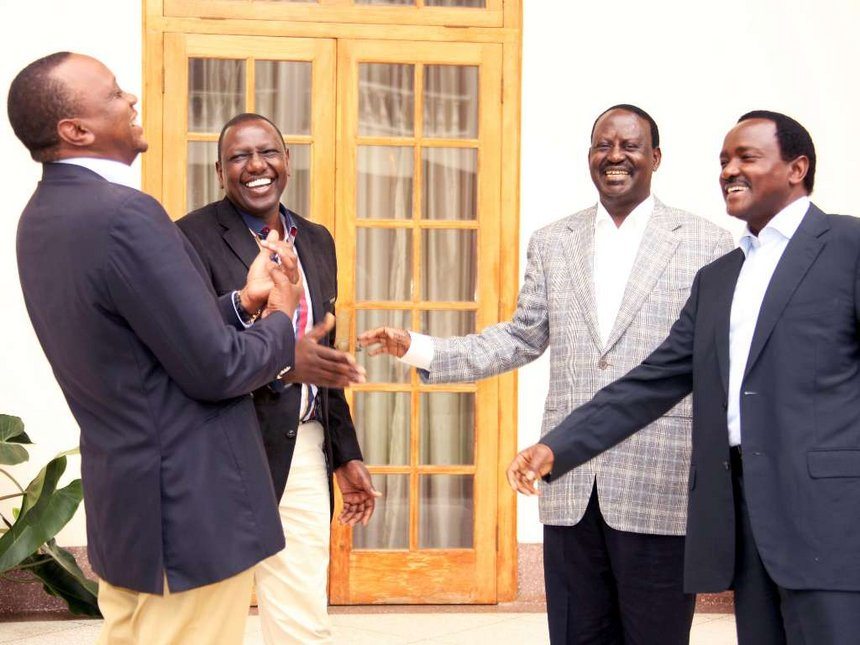
Kenyan top leaders share a joke 


Jubilee, Tano Tena!

Kikuyu Gospel artist Ben Githae has released a campaign song in praise of Jubilee and its leaders incumbent Uhuru Kenyatta and William Ruto. The song “Uhuru na Ruto Tano Tena” is a reminder of the much Jubilee has achieved in their first term in office and urges people to reelect them. The song in Swahili highlights the successes in the Jubilee administration. I have also come across a song by Kamande wa Kioi, a popular Kikuyu artist who sings praises to Uhuru Kenyatta. The song “Uhuru ni witu” sang in Kikuyu was a prayer request to have Uhuru freed from the ICC yoke before his election in 2013.

Onyi Papa Jay 2007 Song

However, the best campaign song has to be Onyi Papa Jay’s ODM song of 2007. The song combined Swahili and Luo lyrics to capture the process leading to the 2007 elections. The song gives a historical analysis of the formation of the ODM party. Combining Swahili and Luo narratives, the song gives details of the 2005 referendum that was won by the Orange team. The ODM team was led by the then Pentagon of Raila, Ruto, Mudavadi, Nyaga, Balala and Ngilu. Using Raila’s football commentary analogy, Onyi Papa Jay passionately narrates how ODM was going to beat PNU in the elections.


Campaign songs are important in mobilizing electorate around an agenda ahead of an election. Songs generally are an important medium of cultural expression in all societies. The campaign songs in Kenya explain the nature of Kenyan political landscape which is largely ethnic. However, the songs have also been embraced by the ethnic communities that make up the specific coalitions.   

Nicodemus Minde
Nairobi, Kenya
10 July 2017

Thursday, 14 August 2014

CCM reading from KANU script, we all know what happened!

Having grown up and gone to school in Kenya at the height of their 'second liberation' one thing was clear: people power reigns. When the agitation for reforms started in the late 1980s, KANU government in a chutzpah fashion cracked its whip by harassing and jailing dissidents. Coinciding with the fall of the Berlin Wall that marked the triumph of liberal democracy, the reform agenda gathered momentum in not only Kenya but the world over. An intransigent President Moi and his government agreed to repel section 2A of the constitution and Kenya became a multiparty democracy in 1991. Despite the opposition loosing the 1992 and 1997 elections, they continued pressing the Moi regime calling for reforms. The opposition saw constitutional reforms as the only way out. When calls for minimum reforms were thwarted by the Moi regime in 1996, prior to the elections the following year, the writing was on the wall for Kenya. Moi went on to easily beat his opponents in the elections in 1997. 

Calls for reforms did not end there. The opposition together with other pressure groups coalesced demanding for change and constitution reforms. A Commission for Constitution Reforms of Kenya was set up in 2000 after intense pressure. Moi regime had began to cave. Despite the brouhaha, Moi continued to dillydally on the process. President Moi anointed Uhuru Kenyatta as his heir apparent since his term was coming to an end in 2002. This did not augur well with a section of KANU politicians who jumped ship. Led by Raila Odinga and a host of other political figures such as George Saitoti, Kalonzo Musyoka, Simeon Nyachae, Mwai Kibaki, Moody Awori, Charity Ngilu and many others coalesced and formed a formidable NARC coalition ahead of the 2002 election. Their agenda was to remove KANU from office and  a championed for a new constitution. Law and behold, the indomitable KANU was resoundingly defeated. Legends and tales of the 'Jogoo' party are still told to date. Ironically, CCM, the 'independence' party seems to be reading from KANU script. With the constitution process in Tanzania at a deadlock, CCM has refused to yield to the opposition demands. 

Tanzania is not Kenya when it comes to politics, neither is CCM KANU. But lest we forget, as Aldous Huxley postulates 'that men do not learn very much from the lessons of history is the most important of all the lessons that history has to teach". 

Thursday, 11 April 2013

Uhuru-Kikwete new found love: Why it is a battle between CCM and Chadema

Nicodemus Minde, Nairobi
Uhuru Kenyatta was sworn in as the fourth president of Kenya in a colorful occasion attended by many African leaders. It was evident in the occasion that Tanzania’s president Jakaya Kikwete was abnormally close to president Uhuru. President Kikwete and President Kenyatta sat together during the state luncheon held at state house. Kikwete, who like Uhuru, is the fourth president of his country. President Kikwete, on behalf of all other invited heads of state and government was tasked to give a vote of thanks after the state lunch. Despite the close historical cooperation between Tanzania and Kenya, the newly found love between Uhuru and Kikwete reveal a number of hidden political dynamics, mostly within the corpus of Tanzanian politics. 

Uhuru and Kikwete discuss a point
Tanzania and Kenya have historically been close regional partners. Though founded on different ideological backgrounds, the two nations have worked closely together for decades. Their relationship has been mostly on the premise of trade, commerce and investments. Close cultural, lingual and historical backgrounds have been the fulcrum of their closely knit relationship. The cordial relationship between Tanzania and Kenya has been cemented further by the East African Community.

Back to the Kikwete-Uhuru close relationship. It is recalled that Uhuru Kenyatta, during his campaign visited Tanzania with a delegation of the Jubilee coalition team. Kikwete hosted Uhuru and his team in Dar-es-Salaam statehouse, where they discussed a number issues. Though he visited a host of many other countries, Uhuru’s reception in Dar-es-Salaam was better organized and far from impromptu as the others. It should further be recalled that Uhuru Kenyatta’s closest competitor in the March 4 election, Raila Odinga is big friend to Tanzania’s leading opposition party Chama cha Democrasia na Maendeleo (CHADEMA). It is believed that Chadema offered Raila Odinga a number of campaign material such as helicopters and campaign trucks and musicians pro bono. With Kikwete as the chairman of the ruling party Chama cha Mapinduzi (CCM), the generous gesture by Chadema towards Raila Odinga was an act of war and therefore, CCM had to support Uhuru Kenyatta. This of course was not done in the open but through proxy. When Uhuru Kenyatta prevailed over Raila Odinga, it was not only a victory for the Jubilee coalition but for CCM in retrospect. The political battle between CCM and Chadema, by proxy was fought and won in the Kenyan elections. As Tanzania gears up for the next general election, the psychological victory by CCM will to an extent influence the campaigns. 

[ZELEZA] Malawi’s Political Earthquake: Nullification of the Presidential Elections

By Prof Paul Tiyambe Zeleza  3/2/2020 The Malawian Constitutional Court has annulled last year's presidential election results....

Most Viewed