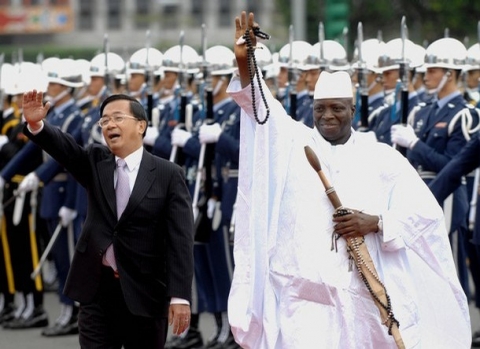
Via CPRA Daily Briefing
In a speech given during
celebrations of the Muslim Eid el-Fitr, the Gambia's President Yahya Jammeh
announced a plan to have all death row prisoners executed. The subsequent
executions sparked worldwide condemnation and lifted the veil on the
increasingly authoritarian regime in the Gambia. They are also likely to raise
concerns over the country's democratic credentials.
The African Union (AU) and various
human rights organisations tried to persuade President Jammeh to abandon this
plan, but were unsuccessful. On Sunday 26 August, nine prisoners were hastily
executed by a firing squad during the night. Some have argued that President
Jammeh could well take advantage of this to rid himself of political figures
accused of plotting against his regime.
According to Amnesty International, there are currently 38 more death
row prisoners awaiting execution. The US State Department has called on
President Jammeh to review the remaining cases and ensure that the Gambia does
not stray from its own or from international law, as it is suspected that due
process has not been followed in these executions. Two of the prisoners
executed on Sunday were Senegalese nationals. Senegalese Prime Minister Abdoul
Mbaye has formally protested against the executions and has asked Gambian
ambassador Mass Axi Gey that the life of a third Senegalese death row prisoner
be spared.
Considering the fact that President
Jammeh has thus far ignored the pleas of the AU and many other international
bodies, it seems unlikely that the executions will be halted by Senegal's
request. As a result President Jammeh's decision is not only further damaging
the questionable human rights record of the Gambia, but is also damaging
relations with its neighbours. While President Jammeh in the past has announced
his ability to cure AIDS and infertility, and has said that all homosexuals
will be beheaded, his latest decision still comes as a shock.
Yet the Gambia hosts the African Court of Justice (sic) [African Commission on Human and Peoples' Rights (ACHPR)] , and is thus meant to be a hub of human rights, but the plan
to keep executing prisoners is a clear indication of the reversal of the human
rights progress and a regression in the democratisation process. In addition to
this, the Gambia is yet to sign and ratify the 1989 Second Optional Protocol on
the International Covenant on Civil and Political Rights (ICCPR), which is
aimed at abolishing the death penalty. Disturbingly, Sunday's events mark the
first executions to take place in the Gambia in 27 years. This raises serious
questions as to why the President would want to reverse this good record.
Unfortunately, the situation does not seem to be unique to the Gambia, as out
of 54 African countries only 16 have legally abolished the death penalty to
date.
In addition to the global move to
abolish the death penalty, backed by the Second Optional Protocol of the ICCPR,
there is an ongoing debate on how, in the rare cases where execution is decided
upon, the person should be executed. If lethal injections, which were once
thought to be the most humane form of execution, are no longer considered to be
all that humane, then death by firing squad (as practiced in the Gambia) is
certainly not humane.
As mandated by their domestic law
and the fact that the country did not sign the Second Optional Protocol of the
ICCPR, Gambian authorities believe they have the right to continue to practice
the death penalty in cases of murder and treason. However, the way in which
President Jammeh is going about the executions bodes ill for his country. The
Gambia has signed the 1984 Convention against Torture and other Cruel, Inhumane
or Degrading Treatment or Punishment, but because it has not been ratified it
is not legally binding. This is quite concerning as prisoners on death row are
often in danger of being subjected to torture or cruel, inhumane treatment. The
Gambia will have to amend its domestic law if it does not wish for its image to
be irreversibly damaged by this lack of due process and lack of legal
protection for prisoners.
President Jammeh said that he
decided to have the death row prisoners executed since he could not allow 99
per cent of the population to be held hostage by one per cent. However, by
making this decision, he forced the Gambia back into a global minority of
countries that still practice capital punishment. Considering the direct
correlation between human rights progress and development, this raises the
question over who is really holding the Gambia hostage.


