Friday, 31 August 2012

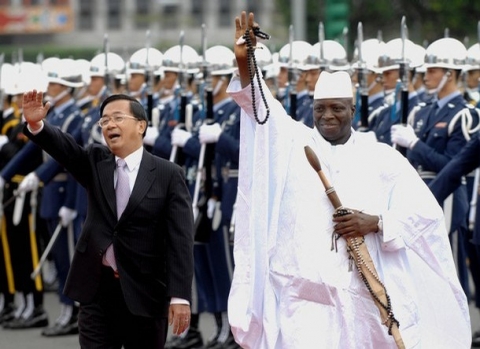
The Gambia: President Yahya Jammeh's order to execute prisoners is an assault on human rights progress


 Via CPRA Daily Briefing
In a speech given during celebrations of the Muslim Eid el-Fitr, the Gambia's President Yahya Jammeh announced a plan to have all death row prisoners executed. The subsequent executions sparked worldwide condemnation and lifted the veil on the increasingly authoritarian regime in the Gambia. They are also likely to raise concerns over the country's democratic credentials.

The African Union (AU) and various human rights organisations tried to persuade President Jammeh to abandon this plan, but were unsuccessful. On Sunday 26 August, nine prisoners were hastily executed by a firing squad during the night. Some have argued that President Jammeh could well take advantage of this to rid himself of political figures accused of plotting against his regime.  According to Amnesty International, there are currently 38 more death row prisoners awaiting execution. The US State Department has called on President Jammeh to review the remaining cases and ensure that the Gambia does not stray from its own or from international law, as it is suspected that due process has not been followed in these executions. Two of the prisoners executed on Sunday were Senegalese nationals. Senegalese Prime Minister Abdoul Mbaye has formally protested against the executions and has asked Gambian ambassador Mass Axi Gey that the life of a third Senegalese death row prisoner be spared. 

Considering the fact that President Jammeh has thus far ignored the pleas of the AU and many other international bodies, it seems unlikely that the executions will be halted by Senegal's request. As a result President Jammeh's decision is not only further damaging the questionable human rights record of the Gambia, but is also damaging relations with its neighbours. While President Jammeh in the past has announced his ability to cure AIDS and infertility, and has said that all homosexuals will be beheaded, his latest decision still comes as a shock. 

Yet the Gambia hosts the African Court of Justice (sic) [African Commission on Human and Peoples' Rights (ACHPR)] , and is thus meant to be a hub of human rights, but the plan to keep executing prisoners is a clear indication of the reversal of the human rights progress and a regression in the democratisation process. In addition to this, the Gambia is yet to sign and ratify the 1989 Second Optional Protocol on the International Covenant on Civil and Political Rights (ICCPR), which is aimed at abolishing the death penalty. Disturbingly, Sunday's events mark the first executions to take place in the Gambia in 27 years. This raises serious questions as to why the President would want to reverse this good record. Unfortunately, the situation does not seem to be unique to the Gambia, as out of 54 African countries only 16 have legally abolished the death penalty to date. 

In addition to the global move to abolish the death penalty, backed by the Second Optional Protocol of the ICCPR, there is an ongoing debate on how, in the rare cases where execution is decided upon, the person should be executed. If lethal injections, which were once thought to be the most humane form of execution, are no longer considered to be all that humane, then death by firing squad (as practiced in the Gambia) is certainly not humane. 

As mandated by their domestic law and the fact that the country did not sign the Second Optional Protocol of the ICCPR, Gambian authorities believe they have the right to continue to practice the death penalty in cases of murder and treason. However, the way in which President Jammeh is going about the executions bodes ill for his country. The Gambia has signed the 1984 Convention against Torture and other Cruel, Inhumane or Degrading Treatment or Punishment, but because it has not been ratified it is not legally binding. This is quite concerning as prisoners on death row are often in danger of being subjected to torture or cruel, inhumane treatment. The Gambia will have to amend its domestic law if it does not wish for its image to be irreversibly damaged by this lack of due process and lack of legal protection for prisoners. 

President Jammeh said that he decided to have the death row prisoners executed since he could not allow 99 per cent of the population to be held hostage by one per cent. However, by making this decision, he forced the Gambia back into a global minority of countries that still practice capital punishment. Considering the direct correlation between human rights progress and development, this raises the question over who is really holding the Gambia hostage.

Real power is in national will, not nuclear weapons: Ayatollah Khamenei

 
Mugabe and Ayatollah Khamenei
Via Press TV
Leader of the Islamic Revolution Ayatollah Seyyed Ali Khamenei says the real power of a country lies in the reinforcement of the national resolve and progress in scientific and social spheres, rejecting nuclear arms as a component of a nation’s power.


“We consider real power in strengthening the national will and socio-scientific advances, not in atomic weapons,” Ayatollah Khamenei said Thursday in a meeting with Zimbabwean President Robert Mugabe who is in Tehran to participate in the 16th summit of the Non-Aligned Movement (NAM).

Ayatollah Khamenei called on all NAM member states to adopt practical measures through collective cooperation.

Mugabe, for his part, denounced Western countries’ “big lies about defending human rights, law and democracy,” adding that “The record of the US, England and France and their double-standard behaviors towards the developments in the Middle East show that Westerners are merely after oil resources.

The Zimbabwean president said the approach of the West to Syria is indicative of a tenuous and fragile plot to undermine the Islamic Republic.

He also denounced as “ridiculous” the Western powers’ allegations that Iran is seeking to acquire military nuclear capability.

NAM, an international organization with 120 member states, is considered as not formally aligned with or against any major power bloc. It represents nearly two-thirds of the UN members.

At the opening ceremony of the NAM expert-level meeting, Iran assumed the rotating presidency of the movement for three years. Egypt's Ambassador to the United Nations Mootaz Khalil formally handed over the presidency to Iran.

Wednesday, 29 August 2012

Iran's Foreign Minister Says Morsi Visit Is a 'Landmark'

 Via Al Monitor
Iranian Foreign Minister Ali Akbar Salehi said Tuesday that his government will not be offended if Egyptian President Mohammed Morsi spends only a few hours in Iran later this week. In an interview with Al-Monitor and Time Magazine on the sidelines of a conference of the 120-member Non-Aligned Movement (NAM), Salehi said the mere “presence” of an Egyptian leader in Iran after decades of estrangement between Iran and Egypt would be a “landmark.” Salehi repeated Iranian offers to help resolve the crisis in Syria — offers that the Barack Obama administration has rejected. The soft-spoken foreign minister, who got his PhD in physics from MIT before the 1979 Iranian revolution and previously served as Iran’s representative to the International Atomic Energy Agency, also said he remains optimistic that a “win-win” solution can be found to Iran’s nuclear confrontation with the US and much of the international community despite the current apparent deadlock in talks between Iran and the five permanent members of the UN Security Council plus Germany (P5+1).

Monday, 27 August 2012

JOHN MNYIKA: Chadema imeanza kuchukua hatua za kisheria dhidi y...


Uongo unoachochewa kisiasa lazima ukomeshwe. Naamini uongozi mzima wa CHADEMA hautalaza damu katika harakati wa kutafuta ukweli na kumsimamia mwananchi wa kawaida.

Nguvu ya Umma.


JOHN MNYIKA: Chadema imeanza kuchukua hatua za kisheria dhidi y...: Mbunge wa Ubungo ambaye pia ni Mkurugenzi wa Habari na Uenezi wa Chama cha Demokrasia na Maendeleo (Chadema), John Mnyika akizungumza na ...

JOHN MNYIKA: Chadema Kimemtaka Katibu Mwenezi wa CCM Nape Nnauy...

JOHN MNYIKA: Chadema Kimemtaka Katibu Mwenezi wa CCM Nape Nnauy...

Friday, 24 August 2012

A reflection on my birthday


I start by thanking the Almighty God for guiding and protecting me to this day when I mark my birthday. I accept his blessings with innermost humility and modesty. I love to quote Psalms 30:12-“That my soul may sing praise to you and not be silent. O LORD my God, I will give thanks to you forever. This verse always inspires me. It is through his grace and love that I today stand proud and with positive progress. So I will sing praise to him and be glad in his blessings.

The Lord has been good to me. It is only last week that graduated with a Master of Arts Degree in International Relations at USIU. These are blessings and I continue to thank the Lord. As I mark this day, I would like to reflect on some issues which I find pertinent in my life.


Having graduated, this day marks an important phase for me to reflect on the life ahead. Having started working, I now understand the complexity of the life after school. This notwithstanding, life after school presents us with an opportunity to embark on the trials and tribulations of life. I see life after school as an avenue for me to better and solidify my personal principles. My lifelong goal is to be part of a modern society where the rights of all people are respected. As I embark in this life journey, my conviction is to be an agent of change, advocacy and model of progress.

I thank my parents, sisters, close friends and all my relatives for being there for me always. I promise not to be compromised in my life pursuit. I will hold these convictions with utmost regard and promise not to relent in my drive for success and being part of a progressive society.

God Bless.

Wednesday, 22 August 2012

Somalia in Transition: New parliament inaugurated

Via Conflict Prevention and Risk Analysis (CPRA) 

A total of 215 parliamentarians were sworn in on Monday, 20 August 2012, at a well-guarded ceremony at the Mogadishu airport, ushering in a new era of reforms in Somalia. The ceremony marked the attainment of one of the key milestones identified by the 2011 consultative meeting on ending the transition in the country. In all, 60 more members are to be added to the new parliament in order to attain the 275 full capacity of the new House, which is supposed to be the Lower House of the post-transition government in Somalia. Despite not being at full capacity, the present number gives the House more than the 185 parliamentarians required to form a quorum. 

Apart from marking a reformed parliament as envisaged in the Roadmap, the swearing-in ceremony is significant in the recent history of Somalia in a number of ways. It is the first time in the more than two decades of conflict in the country that such a ceremony has taken place on the soil of Somalia. Previous attempts to put in place institutions, including parliament, took place outside the country. It is also a reflection of the solid resolve and international commitment to deal with the situation in Somalia and to end the transition in 2012. Somalia has seen a number of extensions in the past and stakeholders are bent on making sure this is not one of those.

The international community and a number of stakeholders have praised the inauguration of the parliament and wished the people of Somalia well. Among the numerous comments on the ceremony, United Nations (UN) Secretary General Ban Ki-moon has called it a '...watershed moment on their road to peace, stability and political transformation', while his representative to Somalia, HE Ambassador Augustine Mahiga, who has been key in all the processes in the run-up to the occasion, has described it as a historic moment that '... marks the long-awaited end of the transitional period in Somalia'.

As stated by Mahiga, 20 August 2012 was the actual date scheduled for the end of the transition and therefore Somalia should in fact have had a parliament, speaker and deputies, and a president in place by that date. However, due to delays in meeting a number of the deadlines largely blamed on the politics surrounding the selection and submission of names by the traditional elders, and subsequently the vetting process by the Technical Selection Committee (TSC), the whole process was delayed. As a result, the deadline has passed without Somalia meeting all the important milestones envisaged under the Roadmap.

Among the crucial milestones remaining is the election of a speaker with his deputies and eventually a president, who will in turn appoint a prime minister. Given the hurdles and allegations of vote buying, and meddling by different stakeholders, the next steps represent the most important stages of the process. They therefore require great caution and circumspection in order not to derail the gains made so far. Already, the rejection of about 70 nominations by the TSC is creating tension as some of the clan leaders are refusing any replacements to the names submitted. Questions are also emerging as to why the TSC is not sticking to the criteria for selection and is rejecting some names, since it is not a court of law. This could foment trouble and ignite the age-old clan factor in the security dynamics of the country, which is capable of derailing the process. Such questions have already significantly affected the legitimacy of the process and need to be watched much more closely.

The politics surrounding the election of the speaker and the president are two remaining crucial issues. This is because the two positions cannot go to the same clan and, as such, clans may try to play their cards to get the optimum result, given the winner-takes-all-nature of the politics surrounding the transition. The situation is still extremely fragile and the country would benefit from maximum support from the international community, while ensuring Somali-centeredness and ownership.

Although Somalia did not meet the deadline for the selection of the speaker and the president, the swearing-in of parliamentarians is a watershed moment for a country that has been riddled with lawlessness for 20 years. The progress made has given new hope to some Somalis and renewed the faith of the international community in the peace process.

[ZELEZA] Malawi’s Political Earthquake: Nullification of the Presidential Elections

By Prof Paul Tiyambe Zeleza  3/2/2020 The Malawian Constitutional Court has annulled last year's presidential election results....

Most Viewed